



You don't buy a new sofa every season. It's where you unwind after work, watch shows, entertain guests, and do absolutely nothing on Sunday afternoons – often for ten years or longer. That's exactly why it pays to look a little closer before you buy. Whether a couch feels worn out after three years or stays comfortable and holds its shape after a decade depends on details you won't notice at first glance.
The good news: You don't need to be an upholstery expert to spot a quality sofa. With a few solid criteria and the right questions, you can tell the difference between quality and mass-produced – whether you're browsing online or test-sitting in a showroom. In this guide, we'll walk through layer by layer what really matters.
The essentials at a glance
- Frame: A stable structure made of solid wood or quality plywood is the foundation. Particleboard, cardboard, or styrofoam are warning signs.
- Spring system: Coil springs or wave/Nosag springs keep the sofa from sagging and squeaking.
- Cushioning: What matters isn't "soft or firm," but foam density and hardness – they determine how long it lasts.
- Fabric: Look for abrasion resistance (Martindale value), low pilling, and color fastness.
- Workmanship & seals: Clean seams, no chemical smell, and recognized quality certificates tell you a lot about durability.
- Price: Expensive doesn't automatically mean better – but very cheap almost always means compromises in materials or workmanship.
Table of contents
- Why a closer look is worth it
- The frame – your sofa's skeleton
- The spring system – the invisible backbone
- The cushioning – where comfort is decided
- The fabric – material that needs to handle daily life
- Workmanship & details – the 5-minute check
- Quality certificates as a guide
- Warranty – a hidden quality promise
- Does a good sofa have to be expensive?
- Your sofa-buying checklist
- Frequently asked questions about sofa quality
Why a closer look is worth it
A sofa is something meant to stay with you for a long time – and that makes it an investment. Cheap models look just as inviting in the showroom or on a product photo as higher-quality ones. The difference shows up later: after hundreds of hours of sitting, after your first move, after a few years of sunlight on the fabric.
Many of the most important quality features are hidden inside, tucked under the upholstery. Manufacturers who cut corners here don't stand out visually at first. But if you know what to look for, you can tell before you buy whether a sofa is built to last. We'll work our way from the outside in – in the exact order a sofa experiences stress.
1. The frame – your sofa's skeleton
The frame literally carries everything. It has to support your weight, your guests' weight, and thousands of sit-downs without giving way. Quality sofas rely on a frame made of solid wood (such as beech, oak, or pine) or sturdy, laminated plywood. These constructions don't warp and hold up to stress over the years.

Be careful if the frame is made of thin particleboard, pressed cardboard, or styrofoam – these are classic cost-cutting measures that lead to squeaking, wobbling, or sagging sooner or later. A practical clue: weight. Quality materials like solid wood and good springs add noticeable heft. A suspiciously light sofa often signals a weak base.
How to check: Ask the salesperson or online shop specifically about the frame material. If nothing's mentioned in the product description or on the label, that's already a small red flag. When you test-sit, feel free to shift your weight and lean on it a bit: A good sofa stays still and stable.
2. The spring system – the invisible backbone
Between the frame and cushioning sits the spring system. It distributes weight, provides bounce-back, and prevents you from sinking in over time. Here are the most common options:
- Coil springs: Spiral steel coils provide supportive, point-elastic seating and last a very long time. In the classic Bonnell coil system, springs are connected to each other, while in the premium pocket coil system, each spring sits in its own fabric pocket and reacts independently – that feels more precise and transfers less movement to your neighbor.
- Wave or Nosag springs: S-shaped steel springs stretched across the frame. They're stable, quiet, and a proven, long-lasting foundation – often combined with cold foam.
- Elastic straps: Woven straps allow for an especially soft feel, but tend to stretch out over time. As the sole support in a heavily used sofa, they're less recommended.
Remember: Good spring support means the seating surface gives way evenly and no hollow spots or "sags" form. If a sofa squeaks or squeals when you sit down, something's wrong with how the springs are anchored.
3. The cushioning – where comfort is decided
The cushioning is the heart of comfort. The common misconception: A firm cushion is automatically higher quality. That's not true. Firmness is a matter of taste – quality is measured by two other values:
- Foam density (ILD): Indicates how many kilograms of material are packed into a cubic meter of foam. The higher the density, the more durable and shape-retaining the foam. For a long-lasting seat cushion, you'll want solid foam density – cheap foam with low density loses its shape fast.
- Hardness: Describes how much resistance the foam gives to your body – essentially how "firm" it feels, independent of density.
To help you compare common cushioning types side by side, here's an overview with their strengths and weaknesses:
| Cushion type | Feel | Pros | Cons | Best for |
|---|---|---|---|---|
| Cold foam | Medium-soft, point-elastic | Very shape-stable, durable, breathable, hypoallergenic, silent, lightweight | High quality (high density) costs more | Cozy lounge and everyday sofas |
| Polyether or PUR foam | Fairly firm, lightweight | Affordable, lightweight, shapeable | Wears faster at low density, less adaptable | Budget sofas, back and arm cushions |
| Bonnell coil | Firm, supportive, zone-elastic | Rugged, good air circulation, affordable | Transfers movement, less precise | Classic firm seating, well-used sofas |
| Pocket coil | Firm, very point-elastic | Precise support, durable, minimal motion transfer | Heavier, more expensive | Demanding users, large sofas for sitting and lounging |
| Wave or Nosag springs | Soft-elastic (as base support) | Stable, quiet, durable foundation | Not a standalone cushion, needs foam topper | Combined with cold foam |
| Down or feather blend | Very soft, "sink-in" feel | Luxurious, cozy comfort, adaptable | Needs regular fluffing, less shape-stable | For those who prioritize ultimate comfort over firmness |

Many quality sofas intentionally layer several cushioning types – for example, Nosag springs as the base, cold foam on top, and a protective fleece on the surface that shields the foam and fabric while keeping the shape intact. A thoughtful layered design is often the best sign of a well-planned sofa.
4. The fabric – material that needs to handle daily life
The upholstery is what you touch every day – and what shows wear first if quality isn't there. Beyond color and look, focus on these technical properties:
- Abrasion resistance (Martindale value): Shows how many rub cycles a fabric can withstand in testing before it wears. The higher the value, the more durable – in a living room, a high Martindale value is a good sign.
- Pilling: The formation of small knots on the surface. A low pilling value means the fabric stays smooth and neat-looking even after extended use.
- Color fastness: Important if your sofa sits near a window – it prevents the fabric from fading in the sun.
- Easy care: Removable, washable covers or stain-resistant treatments make everyday life much simpler, especially with kids or pets.
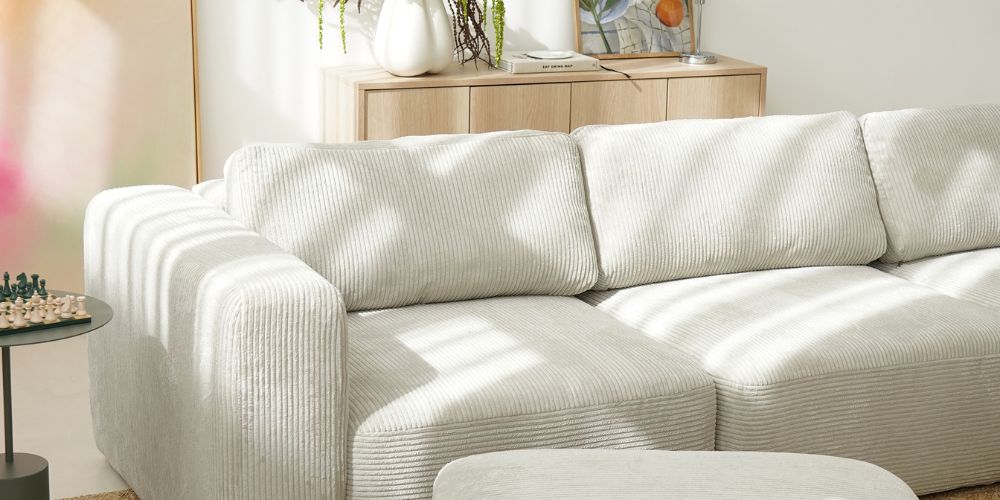
Popular upholstery materials include woven fabric, corduroy, bouclé, microfiber, velvet, and leather. Each has its own personality: Leather is tough and ages beautifully, microfiber is easy to care for, corduroy and bouclé are visually trendy but vary in durability. Best of all, request free fabric samples before you decide – that way you can judge texture and color at home more reliably than on a screen.

5. Workmanship & details – the 5-minute check
Good workmanship shows in small details you can check yourself in just a few minutes – in the showroom or once your sofa arrives:
- Seams: Are they straight, even, and free of loose threads? Crooked or uneven seams signal sloppy manufacturing.
- Back & underside: Even hidden areas should be well-made. If corners are cut here, experience shows they're cut elsewhere too.
- Zippers & fabric: Do they glide smoothly? Does the fabric sit tight and wrinkle-free?
- Smell: A sharp chemical odor can signal residue from manufacturing or shipping. Quality, low-emission sofas smell neutral.
- Legs: Are they firmly screwed in and able to support the weight safely?
A pro tip at the furniture showroom: Check out the display model. These sofas get sat on by many shoppers every day. If the model still looks good despite heavy use, that's a realistic preview of its longevity.
6. Quality certificates as a guide
If you can't check the inner qualities yourself, independent quality seals can help. They confirm that a sofa meets certain objective standards – especially meaningful when granted by a neutral testing body:
- The Gold M (RAL): Marks tested safety, durability, and low chemical content in furniture.
- Oeko-Tex Standard 100: Certifies that textiles meet strict chemical limits.
- Blue Angel: Environmental label for especially low-emission and low-chemical products.
- EMAS: EU label for sustainable environmental management in manufacturing.
A seal doesn't replace your own quality check, but it's a helpful anchor – especially for online purchases.
7. Warranty – a hidden quality promise
Warranty length often says more about quality than you'd think. Manufacturers confident in solid materials and clean workmanship trust their products to last – and offer longer warranties accordingly. While many sofas come with the standard legal two years, quality-focused brands often go well beyond. An unusually short warranty should raise questions.
Does a good sofa have to be expensive?
No – but an extremely cheap sofa almost always involves trade-offs. Quality comes from a sturdy frame, premium springs, shape-stable foam with high density, and a durable fabric. All of that costs something. Save money at the entry level and you often end up paying twice because the sofa needs replacing sooner.
On the flip side: A high price alone isn't a guarantee. Sometimes you're mainly paying for a brand name or designer label. What matters is the balance of materials, workmanship, and warranty – not the price tag by itself. Best to calculate the purchase price over the expected lifespan: A quality sofa that lasts ten years often costs less per year than buying two cheap models in the same span.
Your sofa-buying checklist
Take this list to the showroom or check it before ordering online:
- ☐ Is the frame made of solid or plywood?
- ☐ What spring system is used (coil, Nosag)?
- ☐ What are the foam density and hardness values?
- ☐ What Martindale value and pilling resistance does the fabric have?
- ☐ Are the seams clean and is the back well-made?
- ☐ Does the sofa smell neutral (no sharp chemical odor)?
- ☐ Are there recognized quality certificates?
- ☐ How long is the warranty?
- ☐ Does the price, materials, and lifespan add up?
Frequently asked questions about sofa quality
How do you tell if a sofa is quality?
Look for a combination of a sturdy frame, premium springs, shape-stable cushioning (high density), a durable fabric, and clean workmanship. Quality certificates and a long warranty are additional signs.
Cold foam or coil springs – which is better?
Both can be high quality. Cold foam is point-elastic, lightweight, silent, and hypoallergenic – great for cozy everyday sofas. Coil springs – especially pocket coils – are firmer and more supportive. The best choice depends on your preferred feel.
Which cushioning lasts longest?
High-density cold foam and pocket coils are considered especially durable. Pure polyether or PUR foam with low density wears out faster.
What sofa fabric is most durable?
Sturdy woven fabrics with high Martindale values and leather are considered very resistant. For homes with kids or pets, easy-care or stain-resistant fabrics also make sense.
What does the Martindale value tell you?
It measures how many rub cycles a fabric can take in testing before wearing. The higher the value, the longer-lasting the fabric.
Is a heavy sofa a good sign?
Generally yes. Solid wood, good springs, and dense foam all add weight. A suspiciously light sofa often points to a weaker base – but it's not a universal rule.
Ready for a sofa that delivers on its promise?
Now you know what to look for – from frame to fabric. These exact quality hallmarks go into our sofas: a solid frame, pocket coils, carefully crafted fabrics, and made in Europe.
👉 Explore our modular sofas now and see for yourself – or order free fabric samples first to test texture and color at home.