

Your sofa is set, the pillows are in place – but something's still missing. Most of the time, it's the coffee table. It's the piece of furniture that completes your living room. At the same time, it's the one thing most people hesitate over the longest. Too big, too small, wrong height, odd look next to your new couch? It doesn't have to be that way. Which coffee table goes with which sofa can be answered pretty reliably with a few clear rules and a bit of an eye for proportions. This guide shows you what really matters.
Table of contents
- Three basic rules: size, height, and distance
- Which coffee table shape goes with which sofa
- Color and material: how to make your sofa and coffee table a pair
- The right coffee table for every life situation
- Your modular sofa from mokebo: the flexible starting point
Three basic rules: size, height, and distance
Before you get lost in shapes, colors, and materials, clarify three things. They determine whether your sofa and coffee table work together – or whether one of them looks lost in the room.
Finding the right coffee table size
The rule of thumb is simple: your coffee table should take up about half to two-thirds of your sofa's length. For a 3-seater around 220 cm long, that means a table between 110 and 145 cm. Shorter, and it gets visually swallowed. Longer, and it blocks your walkways.
For a compact 3-seater (about 180 cm), coffee tables between 90 and 120 cm work well. For a generous 4-seater or sprawling sectional, you can go much larger – or work with two smaller tables instead of one big one.
Coffee table height: higher or lower than the couch?
Your coffee table's height should match your sofa's seat height. Ideal is when the tabletop sits at about the same level – or 2 to 5 cm below. That way you can reach your glass, book, or remote comfortably without leaning forward. Most coffee tables are between 30 and 50 cm tall.
A coffee table lower than your couch looks modern and creates a lounge feel. A slightly higher table (around 45 cm or more) works better if you regularly eat at the sofa or work on your laptop. As a rule: coffee tables noticeably taller than your sofa look rather dated – unless you deliberately use them as a dining or work table.
How much space between sofa and coffee table?
Plan for about 40 to 50 cm between your sofa edge and table edge. That way you can comfortably stand up, walk around the table, and still reach everything from the sofa. In small rooms, 35 cm can work too – anything less gets cramped fast. With a large 4-seater or sectional, the distance can easily be 50 cm, especially if the table looks substantial.
Which coffee table shape goes with which sofa
Your coffee table's shape depends on more than just taste. It follows the geometry of your sofa, your room, and your traffic flow.
Coffee table with a straight 3- or 4-seater
With a classic straight sofa, almost any coffee table shape works. A rectangular table echoes the lines of a 3- or 4-seater and feels calm. A round table deliberately breaks those straight edges and brings lightness to the room – especially in smaller living rooms, it's an advantage because it has no sharp corners and is easier to walk around.
Which coffee table for a sectional or L-shaped sofa?
Sectionals and L-shaped sofas offer a wide, deep seating area. Rectangular coffee tables work particularly well here because they take up the length and stay reachable from multiple seats. For an L-shaped sofa, the recommended table size is 120 to 140 cm. If you want to deliberately break up the straight lines, go for a round or oval coffee table – it creates softer traffic patterns and gives the room a more organic feel. That's actually perfect for the current interior trends for 2026, which lean heavily toward round, flowing shapes.
Coffee table for a U-shaped sectional
With U-shaped sectionals, the coffee table sits in the center and needs to be easily reachable from all sides. Square models fill the inner space evenly. Large round coffee tables work well too – they encourage conversation because no one is sitting at the "head" of the table. Pay special attention to distance here: since the seating is deeper, the table needs enough space all around so you don't feel trapped.
Coffee table with a modular sofa
Modular sofas are the biggest sofa trend of recent years – and this is exactly where most guides leave a gap. Because a modular sofa changes its shape. One moment it's a straight 3-seater, the next it's an L-shape with a chaise, then a generous 4-seater lounge.

What does that mean for the coffee table? It needs to be just as flexible as your sofa. Two strategies work well: either a compact round coffee table (Ø 60 to 80 cm) that works in every configuration and moves easily. Or a set of two smaller nesting tables that you can separate, push together, or position individually next to a module depending on your setup. A large, heavy table does exactly the opposite – it limits the flexibility you bought into when you got a modular sofa.
Color and material: how to make your sofa and coffee table a pair
Proportions and shape are the foundation. But whether your sofa and coffee table truly go together often comes down to color and material.
Which coffee table with a gray sofa?
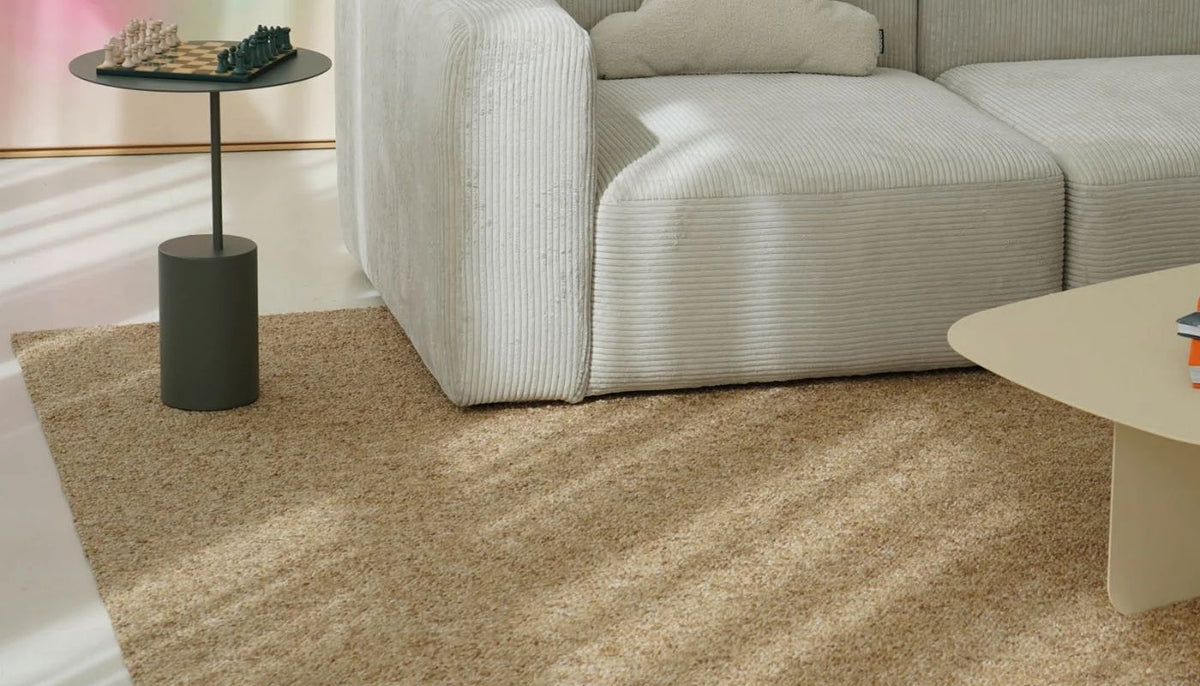
Gray is the all-rounder of sofa colors – and that makes your choice easier than you'd think. With a gray sofa, almost any coffee table material works. Wood in warm tones (oak, walnut) brings warmth to the room and balances out the coolness of gray. Metal in black or anthracite reinforces a modern, minimalist look. Glass feels light and restrained – ideal for small rooms with a gray sofa because the table takes up almost no visual space.
Coffee table materials and their effect
Material choice affects the whole atmosphere of your living room. Wood radiates warmth and pairs well with textured fabrics like corduroy, boucle, or woven material. Solid wood has character but also looks heavier – here it's worth paying attention to more delicate legs or an open frame. Metal (black, gold, chrome) makes clear statements and works well for high-contrast styling. Glass takes a backseat and works especially well if your room is small or your sofa already makes a strong visual impact.
Color pairings that work
A good coffee table doesn't need to match your sofa's color – contrast often looks more interesting than uniformity. With a beige or cream sofa, a coffee table in dark wood or black creates depth. With a dark green or dark blue sofa, light wood or brass works as a counterweight. The rule of thumb: light sofa goes with dark tables, dark sofa goes with light tables. If you want to play it safe, go for a coffee table in a neutral wood tone – it works with pretty much any sofa color.

The right coffee table for every life situation
No guide can tell you which coffee table goes with which sofa without asking: how do you actually live? Because the same sofa-coffee table combo can be great or annoying in everyday life – depending on who lives in your home.
Family with kids
When kids bounce on the couch, roll toys across the table, and bump into corners when they stand up, there's barely any way around a round or oval coffee table. No sharp edges, less injury risk. Plus, a round table is easier to walk around. With material, it's worth choosing something tough: solid wood with a sealed surface or a table with a laminate top handles scratches and spilled drinks better than delicate glass.
Small apartment
In a small space, every centimeter counts. Here, delicate coffee tables with thin legs or glass tops are ideal because they don't visually shrink the room. Nesting tables are especially smart: in everyday life you use just the small one, when guests come over you slide the bigger one in. Coffee tables with built-in storage too – like a shelf under the tabletop or drawers – help you stay organized without needing an extra piece of furniture.

The right height for an eating coffee table
If you regularly eat at your sofa or set your laptop on your coffee table, you need a table with more height. The ideal height for an eating coffee table is about 20 cm above your sofa's seat. With a typical seat height of 40 cm, that would be a table around 60 cm – much taller than a classic coffee table. You get even more flexibility with an adjustable-height model: low surface for everyday use, dining height at the push of a button.
Your modular sofa from mokebo: the flexible starting point
Before you find the perfect coffee table, you need a sofa that plays along. And that's exactly where our modular lounge sofa 'Cubo' comes in.
Whether as a compact 3-seater or a generous 4-seater – 'Cubo' grows module by module with your life. The low overall height of 66 cm gives the sofa real lounge character, which is why a coffee table around 35 to 40 cm tall works perfectly here. The back is completely upholstered, so you can place 'Cubo' freely in the room. For upholstery you can choose from corduroy, woven fabric, and chenille in several colors – depending on which coffee table style you're going for.
About the coffee table: because 'Cubo' changes shape depending on configuration, we recommend a flexible companion – a compact round coffee table (height around 35–40 cm) or two smaller nesting tables that you can freely rearrange. That way your living room stays just as adaptable as your sofa. All 'Cubo' sofas are made in Europe and delivered straight to your living room – we take the packaging back with us.